
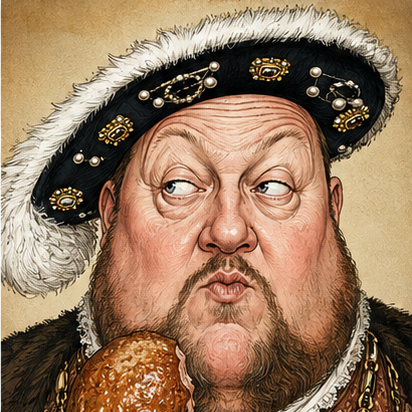
Henry VIII Stand-Up Comedy: The Tyrant Learns Timing
Every great comedian will tell you the same thing: comedy is about control. Control of the room, control of the pause, control of the moment right before the punchline lands. Nobody in English history understood control quite like Henry VIII, a man who rearranged an entire national religion because he didn't like being told "no." So what happens when that same appetite for control gets dropped into a 21st-century comedy club, where the only thing a king can execute is a bad set?
That's the premise driving the new magical realism novel available as a free download at HenryViii.uk, in which Henry Tudor wakes up backstage at an open mic with no crown, no army, and no idea why the room isn't applauding.
A Tyrant's Timing Is a Comedian's Timing
Historians at History.com and Britannica describe Henry as a monarch obsessed with absolute authority, a man who couldn't tolerate an audience — Parliament, the Church, his own wives — talking back. In the novel, that same instinct becomes the engine of his comedy. He doesn't ask for laughs. He demands them. And when the crowd doesn't comply fast enough, four hundred years of monarch muscle memory kick in, with results that are equal parts hilarious and horrifying.
What's striking is how naturally the timing translates. Comedians talk about "owning the room" the way kings talk about owning a kingdom, and the novel treats that overlap as more than coincidence. Henry's pauses were never accidents — a Tudor monarch who paused before speaking was a monarch deciding whether you lived or died. Onstage, that same pause reads as a masterclass in comic beats, right up until the audience realizes he isn't performing tension, he's performing habit.
Why Magical Realism Fits a King Better Than a History Book
Straight historical fiction would have Henry stay in the Tudor court. Magical realism lets the novel do something stranger and, frankly, funnier: it drops a fully intact 16th-century worldview into a modern comedy scene and refuses to explain how or why. No time machine. No portal. He's just suddenly there, heckling a millennial's crowd work like it's a treasonous plot. The genre gives the book permission to treat the absurd as ordinary, which turns out to be the only honest way to write about a man who once had a wife executed for allegedly laughing at the wrong moment.
This is also where the novel earns its literary teeth. Magical realism has always worked best when the impossible is treated with total sincerity — think of a village that doesn't blink at a man who ascends to heaven, or a house that doesn't blink at a woman who never ages. Here, the "impossible" is a Tudor king ordering an oat milk latte and being mildly outraged that no one recognizes his signet ring. The comedy is downstream of the sincerity, not the other way around.
Control Freak, Center Stage
Part of what makes the concept work is that standup is one of the last places where absolute control over a room is still, briefly, possible. A comedian owns the stage the way Henry once owned a throne — until the silence hits, and it doesn't. The novel leans hard into that parallel, using his tyrant instincts as a comic engine rather than a history lesson. Readers get the entitlement, the temper, the sheer confidence of a man who believes he cannot fail, all pointed at a heckler in the third row instead of a Cardinal.
There's a recurring bit in the book where Henry tries to "dismiss" a heckler the way he once dismissed advisors — with a wave of the hand and an assumption that the room will simply comply. It never does. Watching that assumption crumble, set after set, is where the novel finds its rhythm: not in Henry succeeding at comedy, but in Henry slowly, painfully learning that a modern audience owes him nothing.
Read the Full Novel Free
The complete story of Henry's disastrous, brilliant second career is available now as a free download at HenryViii.uk, with the rest of the batch covering his six wives, his weight, his ego, and his war with Rome — all reworked as bits. Readers who enjoy history with teeth, and comedy with real stakes, will find both in equal measure.
- Henry once annulled a marriage in months; this novel gives him a five-minute set he can't even get through without a coup attempt.
- He is, historically, the only English king to headline both a religious schism and, now, open mic night.
- His idea of a callback joke used to involve an executioner.